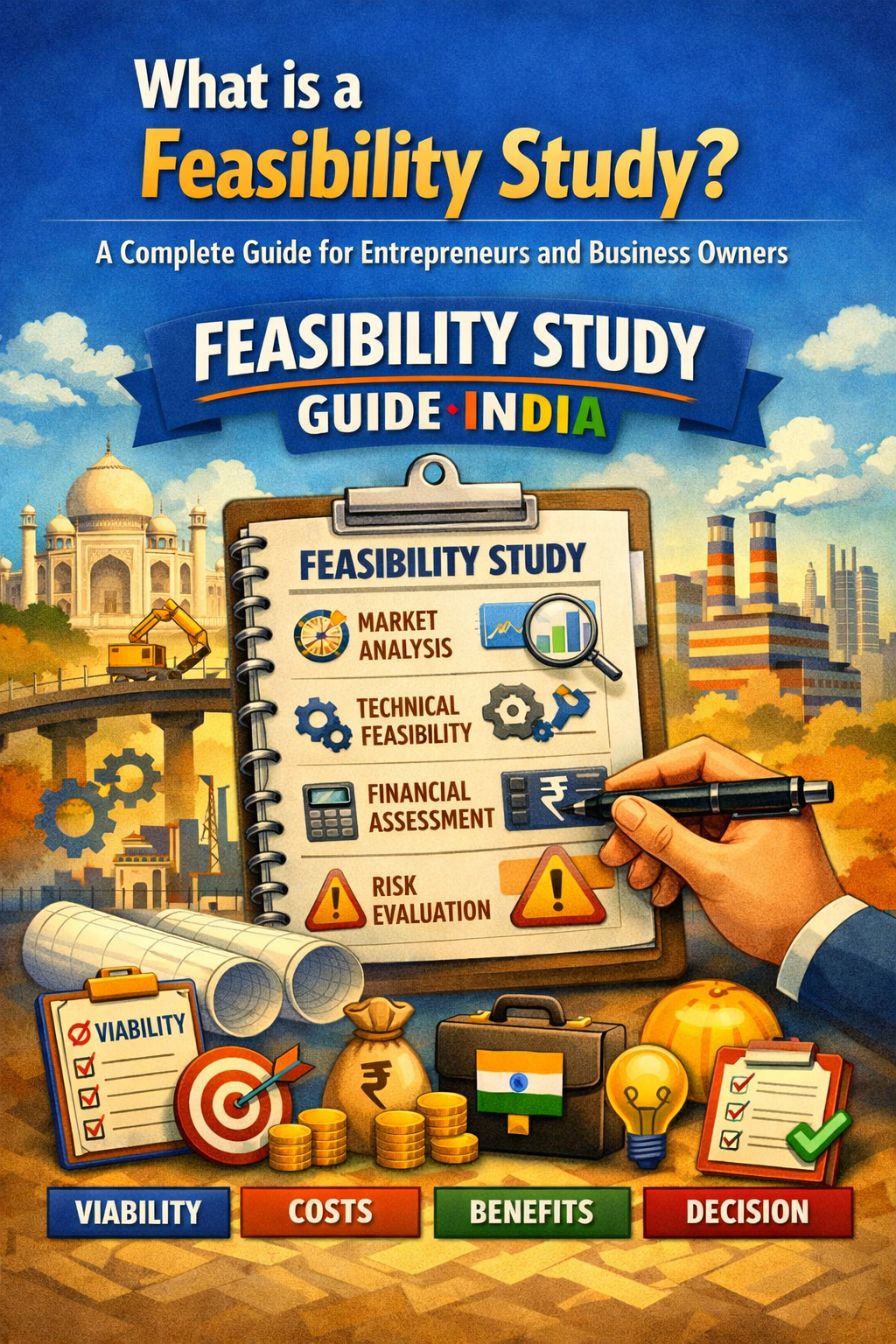
What Is a Feasibility Study? A Complete Guide for Entrepreneurs and Business Owners
A feasibility study is a structured assessment that evaluates whether a proposed business, project, or investment is viable — before money is committed. It examines market demand, financial viability, technical requirements, operational capability, and legal compliance, producing a clear recommendation: proceed, modify, or abandon the idea.
This guide explains what a feasibility study is, what it contains, the different types, when you need one, and how it is different from a business plan and a Detailed Project Report (DPR). If you are preparing a feasibility study for a bank loan or government scheme application in India, Section 7 covers what lenders specifically evaluate.
Why a Feasibility Study Matters Before You Invest
Most business failures are not caused by poor execution. They are caused by poor validation — someone invested capital in a business idea before confirming that the market demand, the financial economics, and the operational requirements actually supported the investment. A feasibility study is the structured process that performs that validation before the commitment is made.
A feasibility study serves two distinct roles. The first is as a decision tool: it gives the entrepreneur, investor, or business owner the evidence needed to make an informed go or no-go decision on the project. The second is as a funding document: in India, a professionally prepared feasibility study is a mandatory requirement for most new project loan applications at nationalised banks, KFC, SIDBI, and government-backed lending schemes including PMEGP, PMMY, and KFC MSME loans.
A well-prepared feasibility study significantly improves loan approval prospects — because it gives the bank’s credit committee credible, independently researched evidence that the proposed project is viable and the loan is serviceable.
In both roles, the quality of the feasibility study is directly proportional to the quality of the decision or the funding outcome it produces.
5 Types of Feasibility Study
A comprehensive feasibility study typically covers five distinct dimensions of viability. Each addresses a different category of risk — and a gap in any one of them can make an otherwise attractive project unviable.
1. Market feasibility |
Assesses whether sufficient demand exists for the proposed product or service in the target market. Covers market size and growth trajectory, customer profile and purchasing behaviour, competitor landscape and market share, and demand projections for the project’s specific geography. Market feasibility is the foundation of the entire study — because a project with strong technical and financial characteristics still fails if the market demand does not support the projected revenue. |
2. Technical feasibility |
Evaluates whether the project can be physically built, manufactured, or delivered given the technology, equipment, infrastructure, and raw material availability in the project’s location. Covers the production process design, machinery and equipment requirements, raw material sourcing and pricing, energy and utilities requirements, and the technical expertise required to operate the project. For manufacturing, food processing, and infrastructure projects, technical feasibility is often the most complex and most scrutinised section. |
3. Financial feasibility |
Analyses whether the project is financially viable — covering total capital investment, revenue projections across the first 3 to 5 years, operating cost structure, gross and net profitability timeline, break-even point, and return on investment. For bank loan applications, financial feasibility includes the Debt Service Coverage Ratio (DSCR) and CMA (Credit Monitoring Arrangement) data that lenders use to assess repayment confidence. Financial feasibility is the most scrutinised section in any bank credit appraisal. |
4. Operational feasibility |
Assesses whether the business can be effectively managed and operated once it is established. Covers management team capability and experience, staffing plan and skill requirements, supply chain and procurement structure, quality control processes, and the operational systems required to run the business consistently. For bank lenders, operational feasibility answers the question: does this team have the capability to actually execute this project? |
5. Legal feasibility |
Examines the regulatory, licensing, and compliance framework governing the proposed project. Covers the specific permits, licences, and environmental clearances required, land acquisition and zoning requirements, sector-specific regulatory approvals (FSSAI for food, MCI for healthcare, PCB for manufacturing, etc.), and any legal constraints that could prevent or delay the project. Legal feasibility identifies regulatory risks early — before they become delays or deal-breakers at the implementation stage. |
What a Feasibility Study Contains — 8 Key Components
A professionally prepared feasibility study follows a structured format. The specific content and depth of each section varies by industry, project type, and whether the study is being prepared for internal decision-making or for a bank or government scheme submission. Here are the eight core components that every comprehensive feasibility study includes.
Executive summary A concise overview of the project, the key findings of the study, and the overall recommendation — written for a reader who may not have time to read the full document. Bank credit officers typically read the executive summary first. A weak or vague executive summary can cause a loan application to be deprioritised before the detailed sections are reviewed. |
Project description A clear description of the proposed business or project — what it is, what products or services it will offer, the business model, the target customer, the proposed location, and the scale of the operation. The project description provides the context for every section that follows. |
Market analysis The primary research foundation of the feasibility study. Covers the target market size, demand profile, customer segmentation, competitor landscape, market share distribution, and demand projections for the specific product or service in the specific geography. For bank loan applications, primary field research — not secondary statistics — produces the most credible market analysis. |
Technical & operational plan Covers the production process, technology and equipment requirements, raw material sourcing and costing, infrastructure and utilities, staffing plan, and the operational systems required. For manufacturing and food processing projects, this section includes plant layout, production capacity, and machinery specifications. |
Financial projections The financial model of the project — including total capital investment, revenue forecasts year by year, cost of goods sold, gross and net profit projections, cash flow statement, break-even analysis, and return on investment. For bank submissions, also includes DSCR, loan repayment schedule, and CMA data formatted to the lender’s requirements. |
Risk assessment An honest evaluation of the key risks to the project’s viability — market risk, execution risk, regulatory risk, financial risk, and external risk — along with the specific factors that mitigate each risk. A credible risk assessment demonstrates that the project promoter has thought through the downside scenarios, not just the optimistic case. |
Legal & regulatory review A summary of the specific permits, licences, environmental clearances, and compliance requirements applicable to the project — with confirmation of whether these have been obtained, are in process, or are planned. For bank lenders, any unresolved regulatory requirement is a risk that affects loan approval. |
Conclusion & recommendation A clear, direct statement of whether the project is feasible, conditionally feasible (subject to specific modifications), or not feasible — supported by the findings of the preceding sections. The recommendation must follow logically from the evidence in the study. A conclusion that contradicts the study’s own findings destroys the credibility of the entire document. |
When Do You Need a Feasibility Study?
A feasibility study is needed whenever a significant capital commitment is being made based on projections rather than established performance. Here are the six most common situations where a feasibility study is required or strongly recommended.
Before applying for a bank loan for a new project Most nationalised banks, KFC, SIDBI, and government-backed lending schemes require a feasibility study as part of the project loan application documentation. The study gives the bank the evidence it needs to evaluate whether the proposed project is viable and whether the loan is serviceable. |
Before investing your own capital in a new venture A feasibility study is not only for bank applications. It is the rational first step before any significant personal or business capital is committed to a new idea — because the cost of a professional feasibility study is always less than the cost of discovering the idea is not viable after the capital has been deployed. |
When applying for government scheme funding PMEGP, KFC startup loans, KSUM seed fund, SIDBI MSME loans, and most central government MSME schemes require project documentation that includes a feasibility assessment. The depth of the requirement varies by scheme and loan amount. |
Before entering a new market or launching a new product An established business expanding into a new geography, launching a new product line, or entering a new market segment needs the same market and financial validation as a new venture. The assumptions that hold in the current market may not hold in the new one. |
Before acquiring a business or entering a joint venture A feasibility study on the target business provides independent validation of the market position, financial performance, operational capability, and risk profile before the acquisition or partnership commitment is made. |
When an investor or partner requires validated project data Many angel investors, institutional investors, and strategic partners require a feasibility study as part of their evaluation process before committing capital to a project — particularly for capital-intensive projects in manufacturing, real estate, healthcare, and hospitality. |
Feasibility Study vs Business Plan vs DPR — What Is the Difference?
Three documents are frequently confused by entrepreneurs and business owners preparing for bank funding or investor presentations. They are related — but they serve distinct purposes, are addressed to different audiences, and are produced at different stages of the business development process.
Feasibility study | Business plan | DPR |
“Is this viable?” | “How will we execute this?” | “What is the full technical blueprint?” |
Pre-decision — before committing capital | Post-decision — after validation | Bank credit appraisal — technical blueprint |
Entrepreneurs, investors, lenders | Investors, banks, leadership teams | Bank credit committees, govt scheme appraisers |
Many businesses preparing for bank funding or investor presentations need more than one of these documents. A feasibility study validates the idea. A business plan maps the strategic execution. A DPR provides the bank with the detailed technical and financial blueprint it needs for credit appraisal. Understanding which document you need — and in which order — avoids the common mistake of commissioning the wrong document for the wrong purpose.
If your bank is asking for a ‘project report’, they typically mean a Detailed Project Report (DPR) — which is more technical and detailed than a feasibility study. Many banks require both: the feasibility study to validate the market and financial viability, and the DPR as the formal credit documentation.
How to Conduct a Feasibility Study — 5 Steps
A feasibility study follows a structured sequence of research and analysis. Skipping steps or treating any section superficially undermines the credibility of the entire study — which is why bank credit committees and experienced investors quickly identify studies that have not been rigorously prepared. Here is the standard process.
Step1 | Define the project scope Clearly describe the proposed business or project — what it is, the target market, the proposed location, the scale of the operation, the investment required, and the specific objective the study must answer. A poorly defined scope produces an unfocused study that fails to answer the questions that matter most. |
Step2 | Conduct primary market research Assess actual demand in the target market through primary field research — consumer surveys, competitor audits, site visits, and demand interviews — not only from secondary sources and industry databases. Primary research specific to your target location in Kerala produces a market analysis that is far more credible with bank lenders than national industry averages. |
Step3 | Evaluate technical and operational requirements Determine the specific production process, machinery and equipment, raw material sourcing, infrastructure, staffing, and operational systems required to run the project. Cost every component at current market prices. Identify any technical risks or resource availability constraints. |
Step4 | Build the financial model Project revenue, cost of goods sold, gross and net profit, capital investment, cash flow, and break-even across a minimum of three years. Every revenue assumption must be anchored to the market research findings. For bank loan applications, also calculate DSCR and prepare CMA data in the format required by your specific lender. |
Step5 | Assess risks and write the conclusion Identify the key risks to the project’s viability — and the specific factors that mitigate each risk. Produce a clear, evidence-based conclusion that states whether the project is feasible, conditionally feasible, or not feasible. The conclusion must follow from the evidence, not from the promoter’s wishes. |
Each of these steps requires research, financial modelling expertise, and judgement about what the findings mean. This is why most businesses commission a professional feasibility study rather than preparing one independently — particularly when the study will be reviewed by a bank credit committee or an experienced investor.
Feasibility Study for a Bank Loan — What Indian Banks Evaluate
In India, a feasibility study submitted as part of a bank loan application for a new project is evaluated by the bank’s credit committee against specific criteria. Understanding what the bank is looking for — and preparing the feasibility study accordingly — is the difference between a credible application and one that is returned for revision or rejected.
Here is what Indian bank credit committees specifically assess in a feasibility study submission:
What the bank evaluates | What this means for your study |
Market analysis credibility | Is the demand data based on primary field research in the specific location, or on secondary national statistics? Primary research produces a more credible market analysis. |
Revenue projection realism | Are the revenue assumptions defensible? Can the promoter explain and justify each assumption if challenged? |
DSCR (Debt Service Coverage Ratio) | The bank’s primary repayment metric. A DSCR above 1.25 is typically required for project loan approval. This must be calculated correctly from the financial model. |
CMA data | Credit Monitoring Arrangement data — a structured financial format required by most nationalised banks. Must be prepared to the bank’s specific template. |
Management & operational capability | Does the promoter or management team have the experience and capability to execute this project? |
Regulatory compliance | Are all required permits, licences, and clearances obtained, in process, or clearly planned? |
A feasibility study prepared by a professional consultant — using primary market research, a correctly structured financial model, and lender-standard documentation — is significantly more credible with bank credit committees than one prepared by the applicant. Banks that regularly see Bramma-prepared feasibility studies recognise the document format and the research methodology.
Need a Feasibility Study for Your Business or Bank Loan Application?
Bramma Global prepares bank-accepted feasibility studies for businesses across Kerala — covering all sectors, all lenders, and all project types. Our feasibility studies are used by businesses applying for loans at KFC, nationalised banks, Federal Bank, South Indian Bank, and SIDBI. Primary market research is conducted in your specific location by our field research team. Standard delivery in 21 to 30 days.