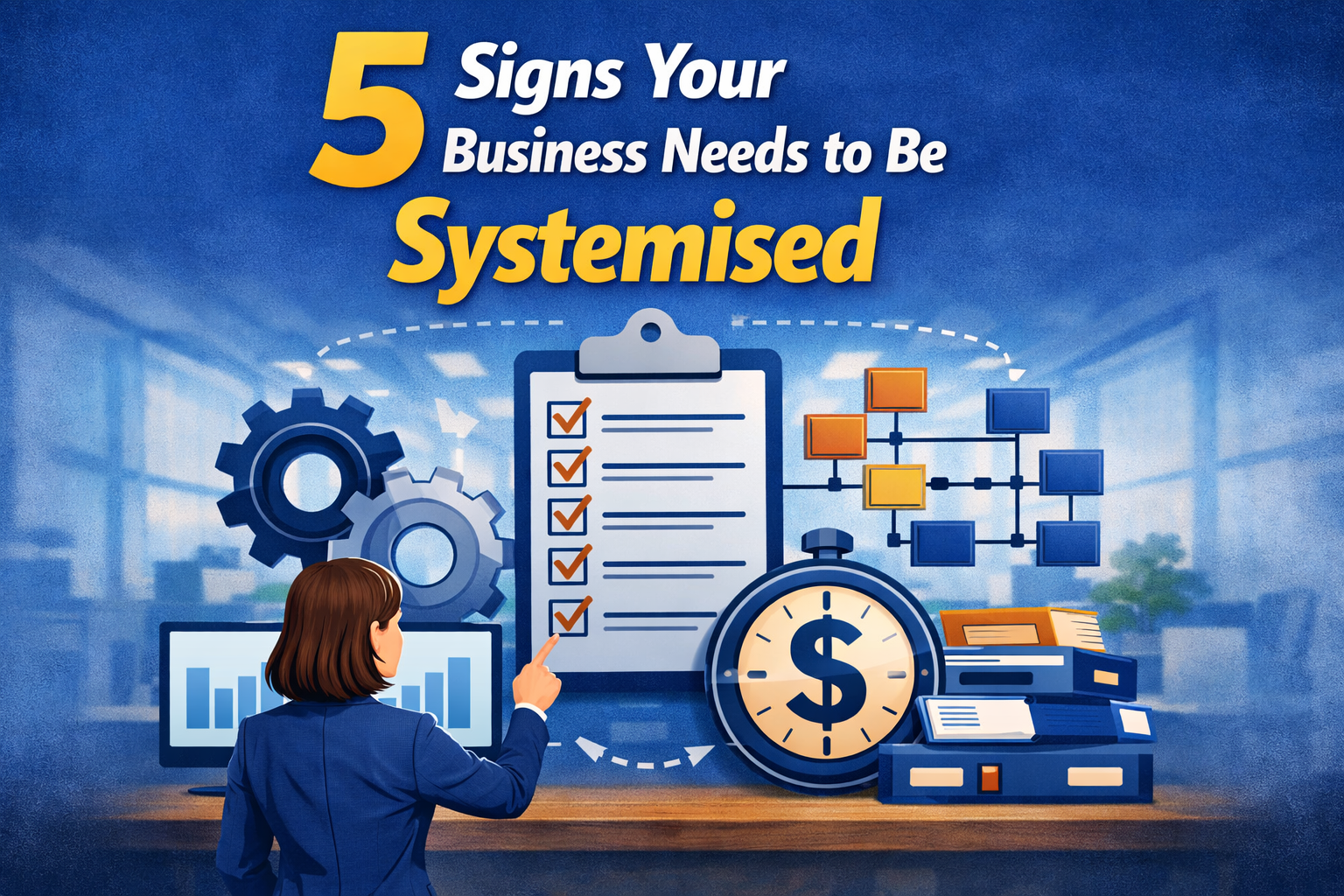
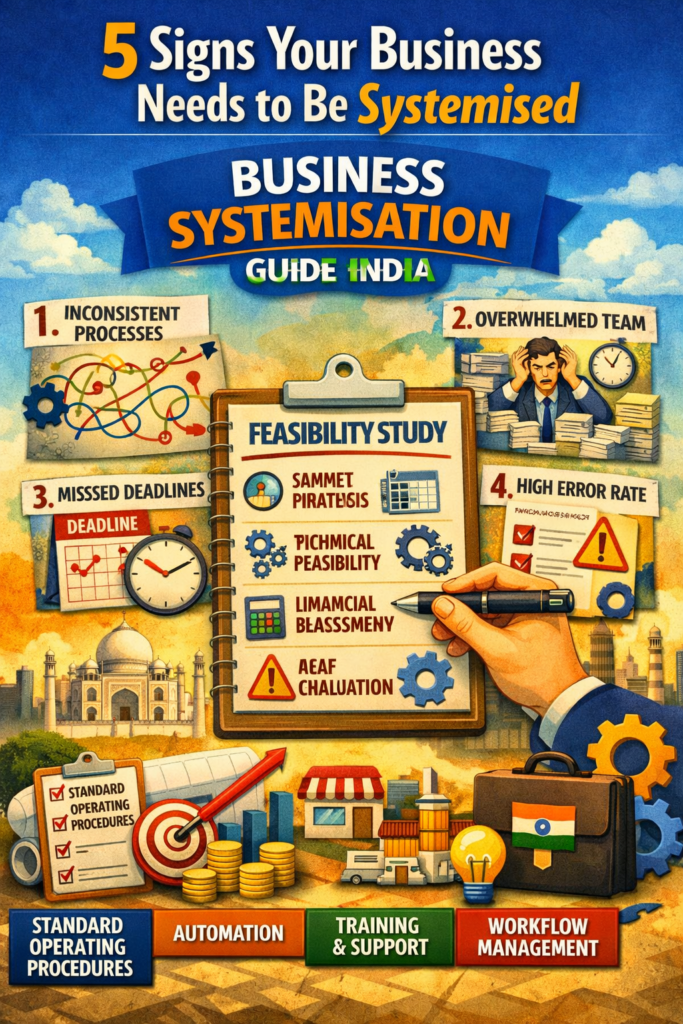
Most Kerala business owners do not realise their business needs systemisation until the problem has been costing them for years. It does not announce itself with a crisis or a clear turning point. It reveals itself gradually — through small frustrations that become daily patterns, through growth that keeps arriving but somehow never makes things easier, through a nagging feeling that the business is running you rather than you running it.
If you have ever thought ‘I cannot take a break without something going wrong’ — you are likely running an owner-dependent business. And owner-dependency is not a personality problem or a management style. It is a systems problem. The business has grown without building the processes and structures that would allow it to function without your constant involvement.
Here are five signs that your business needs to be systemised. If three or more of these describe your business, the underlying problem is almost certainly the same — and there is a structured solution for it.
SIGN 1 You Cannot Take More Than a Few Days Away Without the Business Struggling |
THE PATTERN — You took a few days off for a family trip. On day two, you were on the phone. On day three, you were making decisions remotely. On day four, you came back early. You told yourself it was an unusual week. But it is the same every time you try to step away. The business needs you present to function — and you know it. |
WHY IT HAPPENS — The business is running on your personal involvement, not on documented processes. Every decision, every exception, every unusual customer request eventually reaches you — because you are the only one who knows how things are supposed to work. There are no Standard Operating Procedures. There is no system that exists independently of you. There is just you — present, available, and necessary for the business to function each day. |
WHAT SYSTEMISATION DOES — A systemised business can run — imperfectly but functionally — without the owner’s constant involvement. The goal is not to make yourself redundant. It is to make your presence a strategic choice rather than a daily operational necessity. When processes are documented and roles are clear, the business has a system to follow when you are not in the room. |
SIGN 2 Your Team Asks You Before Making Any Decision, No Matter How Small |
THE PATTERN — A customer calls with a complaint your team has handled five times before. They still escalate it to you. A supplier sends a revised quote. Your team forwards it to you rather than responding. A staff member arrives ten minutes late. Someone texts you to ask what should be done. Each individual situation seems minor. Collectively, they consume three or four hours of your day, every day, for decisions that should never reach you. |
WHY IT HAPPENS — Decision escalation happens when team members have not been given clear authority, clear processes, or clear standards for the situations they regularly face. When nothing is documented, everything becomes a judgement call — and nobody wants to get the judgement wrong. So the safe choice is always to ask the owner. The team is not failing. They are responding rationally to an environment where the consequences of an independent wrong decision are unclear and the cost of asking is low. |
WHAT SYSTEMISATION DOES — Process documentation defines which decisions team members can make independently, which require a manager, and which require the owner. Most of what currently reaches your desk should never reach it. When the decision framework is documented and communicated, your team can act confidently because the process tells them what to do — and they know they are doing it correctly. |
SIGN 3 You Solve the Same Problems Over and Over — and They Keep Coming Back |
THE PATTERN — A customer received the wrong order last month. You fixed it personally and made sure it would not happen again. It happened again this month. A new staff member made the same mistakes in their first three weeks that the previous new staff member made in their first three weeks. Your accounts receivable is late this quarter for the same reason it was late last quarter. You are in a cycle of solving problems that reappear. |
WHY IT HAPPENS — Recurring problems are a symptom of absent processes. When you solve a specific incident without fixing the underlying process that produced it, the incident recurs as soon as the conditions recur — with the next customer, with the next new staff member, with the next month-end. Without a documented process, every new person makes the same mistakes because there is no map to follow. Every exception produces the same chaos because there is no documented way to handle it. |
WHAT SYSTEMISATION DOES — Business Process Reengineering identifies the root cause of recurring problems and redesigns the process that produces them. When the process is fixed, the problem stops recurring — not because people try harder or pay more attention, but because the system no longer produces the error. The fix is permanent rather than temporary because it addresses the cause, not the symptom. |
SIGN 4 Revenue Is Growing but Your Profits Are Not Keeping Pace |
THE PATTERN — Your turnover has grown by 25 to 30 percent in the last two years. But your net profit margin has stayed roughly flat — or has actually declined. You are doing significantly more work, managing more orders, handling more staff, dealing with more customer situations — and the money in your account at the end of the month does not reflect the effort you are putting in. Growth is happening but it is not translating into financial progress. |
WHY IT HAPPENS — Operational chaos is expensive. Rework costs money. Staff who are unclear about their responsibilities waste time and produce inconsistent outputs. Orders that go wrong require resolution time, replacement cost, and often a damaged customer relationship. Customer service failures generate complaints, refunds, and churn. When processes are absent, the cost of errors, exceptions, and manual management oversight grows proportionally with every rupee of revenue — eating the margin that growth should be producing. |
WHAT SYSTEMISATION DOES — Systemised operations reduce the hidden costs of running an unsystematised business: rework, management overhead, customer service recovery, inconsistent quality, and the time you spend personally managing situations that a process should handle. The same revenue, delivered through efficient and consistent processes, produces significantly more profit — because fewer resources are consumed fixing problems that the system should prevent. |
SIGN 5 You Have Tried to Delegate — but It Never Quite Works |
THE PATTERN — You promoted a capable team member into a management role. It did not produce the results you expected. You gave a task to a reliable staff member with what felt like clear instructions. It came back wrong or incomplete. You delegated a key customer relationship and found the customer calling you directly within two weeks. You have concluded, perhaps more than once, that your team simply cannot handle more responsibility. That conclusion may be the most expensive mistake you are making. |
WHY IT HAPPENS — Delegation without process is an instruction without a map. When you delegate a task, you are transferring knowledge — accumulated over years of running the business — to someone who does not have it. You know how things work because you built the business. They do not know how things work because nobody has written it down. Without documented processes, there is no map. The person you are delegating to makes their best guess, gets it wrong, and either fails visibly or comes back to you for guidance. You conclude they cannot do it. They conclude they should not try again. The cycle reinforces itself. |
WHAT SYSTEMISATION DOES — Systems are the bridge between delegation and execution. When processes are documented, roles are defined, and standards are clear, delegation works — because the person you are delegating to has a map, not just an instruction. They know what the expected output looks like. They know what to do when something goes wrong. They know the boundaries of their authority. Delegation fails without systems. With systems, it becomes the primary mechanism through which the business grows without requiring more of the owner. |
The Root Cause Is Always the Same
If three or more of these five signs describe your business, the root cause is the same regardless of which specific symptom you recognise most: you are running a people business, not a systems business. Your business depends on specific people — primarily you — showing up and making the right calls every day. That dependency is not a sign of your value to the business. It is the ceiling on your growth, your freedom, and the long-term value of what you have built.
A business that cannot function without its owner is worth less than a business that can. It cannot scale without the owner scaling with it. It cannot be sold, invested in, or handed to the next generation without the owner being part of the transaction. The systems that your business is missing are not just operational tools — they are the foundation on which every other growth ambition depends.
Systemisation does not mean removing the human element from your business. It means building a foundation of documented processes, clear roles, and structured accountability that allows the people in your business — including you — to perform at a consistently higher level with less friction, less fire-fighting, and less daily dependence on any single person.
What Systemising Your Business Actually Looks Like
Systemisation is not a software purchase, an organisational restructure, or an overnight transformation. It is a structured process that typically runs 120 to 180 days for an SME — covering four core phases.
First, the diagnostic: mapping how your business currently operates across sales, operations, HR, finance, and reporting. Identifying where the critical gaps are, where owner-dependency is highest, and where the most impactful changes can be made. Second, the redesign: documenting the processes that are missing, rewriting the ones that are broken, redefining roles and accountability structures, and building the reporting framework that gives you visibility without requiring your involvement in every decision. Third, the implementation: introducing the new processes to your team, training them on the new system, setting up the tracking and accountability structures, and monitoring early adoption. Fourth, the embedding: refining what is not working, resolving team resistance, and handing over a self-sustaining system that the business can maintain and build on independently.
Bramma Global’s Business Process Reengineering programme works with Kerala SMEs through exactly this process. Most clients begin seeing measurable improvements in team accountability, operational consistency, and management overhead within the first 60 days of implementation — well before the full programme is complete.
The training and development work that embeds new processes into team behaviour runs alongside the BPR engagement. And for businesses where the sales process is part of the owner-dependency problem, sales and marketing streamlining addresses the revenue side of the systemisation challenge simultaneously.
If You Recognised Your Business in These Signs, the Next Step Is a Conversation
Bramma Global has worked with 3,200+ Kerala businesses across 15 years. Most of the business owners who eventually engage Bramma for a BPR programme recognised themselves in exactly these signs — often years before they acted on it. The ones who acted earlier spent fewer years working in a business that was working against them.
If three or more of these five signs describe your business, the next step is a free consultation — not a commitment. In that conversation, we will tell you honestly whether systemisation is the right solution for your specific situation, what the engagement would look like, and what a realistic outcome is. No obligation. No sales pressure. Just a direct conversation about whether your business has a systems problem and what can be done about it.